Spanish
 English
 French
 Russian
 Portuguese
 Arabic
Step 1: Measure Four Things Before You Shop
Take a tape measure into the field. These four numbers eliminate most of the range before price ever enters the conversation:
| Measurement | Why It Matters | Target |
|---|---|---|
| Narrowest aisle | Greenhouse post spacing or orchard row | Machine width + 150 mm per side |
| Lowest clearance | Tunnel truss, branch height, shed door | Machine height + 100 mm |
| Working area | Sets how much power is economic | Hectares actually cultivated |
| Soil type | Clay needs one power class higher than loam | Light / medium / heavy |
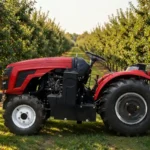
A 12–22 HP mini tractor is roughly one metre wide and one metre tall. That is the whole reason the class exists: it goes where a 50 HP machine physically cannot. If your aisles are 1.2 m, you have already chosen the machine — now you are only choosing the engine.
Step 2: Pick the Power Step That Matches Your Soil
Within this class, each step buys a specific capability rather than a vague “more power”:
| poder | Representative Model | What It Buys | Weight |
|---|---|---|---|
| 12 HP | WX12 | Light tillage, tightest budgets, smallest plots | Entry class |
| 15 HP | MN15 | 1.2 m tiller in medium soil, greenhouse and orchard work | 480 kg |
| 18 HP | MN18 | Same footprint, holds working speed in heavier soil and trailer work | 490 kg |
| 22 HP | WX22 | Top of the mini range; speed rather than new capability | Upper class |
The practical guidance we give buyers: 15 HP covers most greenhouse and small-orchard work. Move to 18 HP when the soil is heavier, when the tiller runs at full depth for hours, or when the tractor also pulls a loaded trailer. Going to 22 HP buys speed, not capability — the machine is still one metre wide and still limited by a single cylinder.
For the full model comparison, see the mini tractor overview.
Step 3: Understand What 2WD Really Means Here
Almost every machine in this class is two-wheel drive, and that is not a cost compromise — it is the correct engineering choice for the job. A 480 kg 2WD tractor compacts raised beds far less than a 1,580 kg 4WD machine, and it is narrow enough to keep off the bed edges entirely.
What makes 2WD workable at this weight is the differential lock, which is standard on our units. Without it, a light two-wheel-drive tractor spins one wheel the moment the ground is loose. With it, both rear wheels pull and the machine keeps moving through freshly tilled soil.
Choose 4WD only when you genuinely need it: slopes above roughly 10%, wet clay, or PTO implements that load the rear axle heavily. In those cases, step up to the low-profile orchard class — the HQ504ED is 50 HP and 4WD but still only 1,240 mm wide.
Step 4: Match the Implement Before You Sign
Mini tractors earn their keep through implements, and the specification trap is always the same: PTO and hydraulic lift are optional on budget configurations. Buy a machine without them and discover you need a rotary tiller, and you are facing a retrofit that costs more than the option did.
- PTO: mandatory for any driven implement — tillers, mowers, sprayers.
- Hydraulic lift: needed to raise and control mounted implements.
- Tiller width: a 1.2 m / 24-blade unit is the reference pairing for 15–18 HP in medium soil. Wider is not better; it shortens clutch life.
- Tráiler: keep it to about 1.5 t behind a 15–22 HP machine, and check brake rules if it goes on public roads.
See the 1GQN rotary tiller range for width-to-power matching, and agricultural trailers for payload guidance.
Step 5: Do the Container Maths (If You Are Importing)
For importers, the commercial case for this class rests on one number: 50 units per 40HQ container, including rototillers. That loading density is what keeps freight per unit low enough to compete with locally assembled machines.
Three practical consequences:
- Mix models rather than ordering one type. Fifteen 15 HP and fifteen 18 HP units, plus tillers and a spare-parts kit, serves a wider customer base than fifty identical machines.
- Ship spare parts with the tractors. Filters, clutch plates and tiller blades cost little to add and save your customers months of waiting.
- Confirm the loading plan in writing. Units, tillers and parts must all be secured; a shifting container is an insurance problem, not a shipping problem.
The Five Mistakes Buyers Actually Make
- Buying power before measuring width. The machine does not fit, and no engine specification saves it.
- Skipping PTO and hydraulics to save money. The cheapest line on the quotation becomes the most expensive retrofit.
- Oversizing the tiller. A 1.4 m tiller on an 18 HP tractor works — until the clutch does not.
- Choosing a 4WD machine for a greenhouse. Extra weight and cost, on ground where traction was never the problem.
- Comparing purchase price instead of landed cost. Freight, implements and spare parts change the ranking more than the ex-works price does.
When You Should Step Up to 50 HP
The mini class stops making sense when your work moves from inter-row cultivation to open-field primary tillage. Two signals: you are ploughing more than a hectare a day, or your implements are wider than the machine itself. At that point the 50 HP range delivers roughly three times the power for a similar order of magnitude in price — and a completely different set of constraints on width and weight.
Frequently Asked Questions
Is 15 HP enough for a one-hectare vegetable farm?
Yes, for tillage, cultivation and hauling. A one-hectare operation is limited by labour and timing, not by tractor power.
Can a mini tractor replace a walking tractor?
For pure tillage in very tight spaces, a walking tractor is cheaper. A mini tractor wins once you need to sit, carry a load, or run a mounted implement for hours.
Do I need 4WD for orchard work?
Usually not. Orchard floors are firm enough for 2WD with a differential lock. 4WD helps on slopes and wet clay, and costs more in price, weight and fuel.
How long do these engines last?
The single-cylinder S1100/S1105 family is the most widely serviced small diesel in export markets. Service life depends on load and maintenance rather than on brand, and top-end overhauls are inexpensive.
Can I order a sample unit before a full container?
Yes. Single units and mixed trial orders are possible, though freight per unit is higher. Many importers start with a mixed container of two or three models instead.