


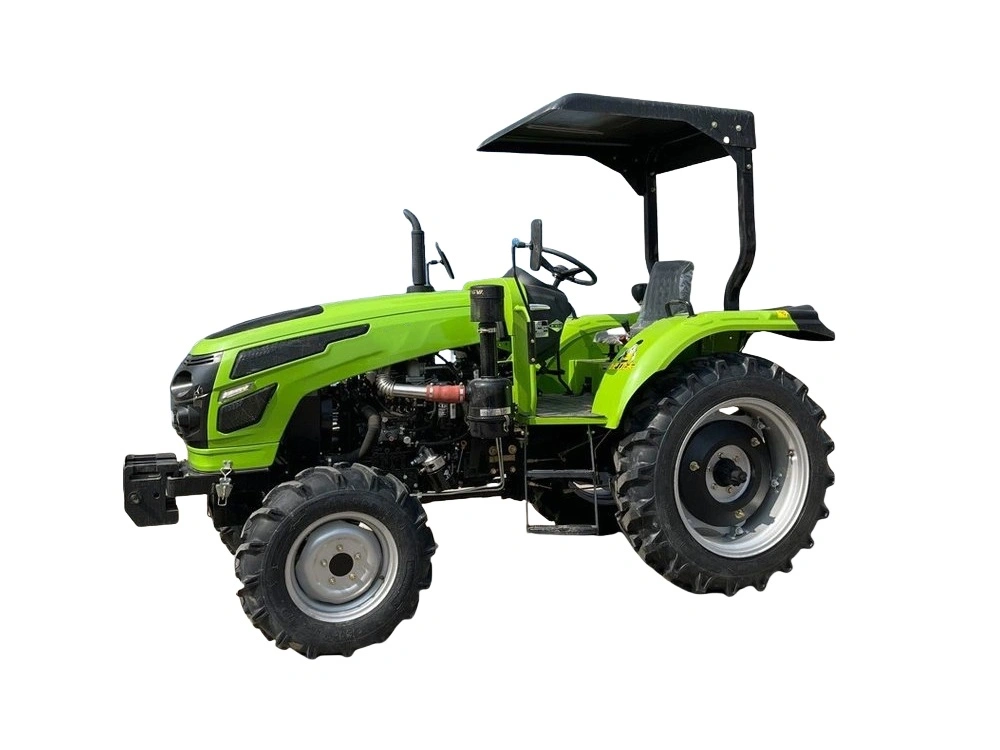

The same Quanchai single-cylinder platform in two widths. The MN is 1,000 mm wide for greenhouses, terraces and narrow rows. The WX is 1,400 mm wide with larger rear tyres for open ground and side slopes. A built-in differential lock is standard on every model.
The MN and WX series are the same tractor wearing two different bodies, and the choice between them comes down to one measurement: how wide is your narrowest gap. Both use a single-cylinder Quanchai engine, a 6F+2R gearbox and a built-in differential lock. The MN is 1,000 mm wide and 2,100 mm long. The WX is 1,400 mm wide and 2,300 mm long, with a wider rear track that makes it stable on side slopes and able to carry a 1.2 m tiller without working outside its own footprint. Everything else about the range is the same, from the 470 kg of the MN12 to the 595 kg of the WX22.
MN at 1,000 × 2,100 mm for row crops and greenhouse alleys. WX at 1,400 × 2,300 mm for open ground, side slopes and 1.2 m implements.
Standard on every model, not an option. With one wheel in a wet furrow, the lock is what gets you out without a second person and a shovel.
12, 15, 18, 20 and 22 HP from five engines of one family. Same maintenance routine, same tools, same mechanic — only the bore changes.
Six forward speeds across two ranges plus two reverse. No synchromesh, which is normal in this class: stop, select, release.
Light enough to cross a timber footbridge and to haul on a small trailer, heavy enough to hold a mounted tiller at depth in dry soil.
The MN range loads 50 units including rototiller; the wider WX loads 42–45. Iron-shelf packaging is standard for container shipment.
Buyers usually start with horsepower. It is the wrong starting point for this class. A 22 HP tractor that cannot pass between your greenhouse posts is worth less than a 12 HP tractor that can, and the price difference will not console you in the second season.
The two bodies solve two different geometry problems, and the numbers make the trade-off explicit:
| Measurement | MN series | WX series | What it decides |
|---|---|---|---|
| Overall length | 2,100 mm | 2,300 mm | Turning space at row ends; trailer towing stability |
| Overall width | 1,000 mm | 1,400 mm | Whether it enters the alley at all |
| [PT-BR translation unavailable] Height | 1,000 mm | 1,300 mm | Clearance under low structures and fruit canopies |
| Front track | 1,000 mm | 1,200 mm | Steering feel; scrub at full lock |
| Rear track | 1,200 mm | 1,400 mm | Side-slope stability; implement coverage |
| Practical tiller width | 0.8–1.0 m | 1.2 m | Matches the rear track, so no strip is left unworked |
The rear track figure is the one people overlook. A tiller wider than the rear track leaves the machine walking in freshly tilled soil on one side, which is both uncomfortable and slow. Matching tiller width to track is not an aesthetic preference — it is how the machine tracks straight.
Measure three things before ordering: your narrowest gate or alley, the height of your lowest truss or branch, and the width of the implement you intend to run. Send us those three numbers and the width question answers itself.
The range covers 12 to 22 HP with five engines. The differences are real but narrow, and understanding where they sit prevents both under-buying and over-buying.
| Modelo | Motor | Potência nominal | Weight | Tyres (F / R) | 40HQ |
|---|---|---|---|---|---|
| MN12 | Quanchai S195 | 8.8 kW (12 HP) @ 2,200 | 470 kg | 500-12 / 600-12 | 50 units |
| MN15 | Quanchai S1100 | 11.0 kW (15 HP) @ 2,200 | 480 kg | 500-12 / 600-12 | 50 units |
| MN18 | Quanchai S1105 | 13.23 kW (18 HP) @ 2,200 | 490 kg | 500-12 / 600-12 | 50 units |
| WX12 | Quanchai S195 | 8.8 kW (12 HP) @ 2,200 | 510 kg | 500-12 / 600-12 | 45 units |
| WX15 | Quanchai S1100 | 11.0 kW (15 HP) @ 2,200 | 560 kg | 500-12 / 650-16 | 45 units |
| WX18 | Quanchai S1105 | 13.23 kW (18 HP) @ 2,200 | 585 kg | 600-12 / 950-16 | 42 units |
| WX20 | Quanchai S1110 | 14.7 kW (20 HP) @ 2,200 | 585 kg | 600-12 / 950-16 | 42 units |
| WX22 | Quanchai S1115 | 16.2 kW (22 HP) @ 2,200 | 595 kg | 600-12 / 950-16 | 42 units |
Two patterns are worth pointing out. First, the WX18 and WX20 weigh the same 585 kg and differ by 1.5 kW — the WX20’s extra power costs almost nothing structurally, which makes it the sensible choice if your soil is heavy and you are already committed to the wide body. Second, the tyre jump happens at WX15, not at the top: from 600-12 / 950-16 upward, the WX runs a substantially larger rear tyre than the MN, and that is what gives it grip on loose ground rather than the horsepower badge.
The MN’s value is not primarily in its price. It is in the places it can reach. A 1,000 mm body fits where nothing with four wheels and a cab fits:
The WX, by contrast, exists for buyers who need the same simplicity on open ground. The wider track is a stability measure: at 1,400 mm rear track the machine sits flat on a side slope where the MN would lean, and the larger rear tyres put more rubber on loose or stubble ground. If your land is flat, open and worked in blocks, the WX is the better machine at the same horsepower. If your land is divided by fences, walls, posts and terraces, the MN’s narrowness is worth more than the WX’s stability.
Most small tractors in this price band offer a differential lock as an extra. On the MN and WX it is built in, and that single feature changes how the machine behaves in wet conditions.
Without a lock, an open differential sends power to the wheel with least resistance. Put one rear wheel in a wet furrow or on cut grass and that wheel spins while the loaded wheel stands still — the tractor stops, and the operator gets off. With the lock engaged, both rear wheels turn together, and the loaded wheel pulls the machine forward.
Two operating rules matter. Engage the lock before you enter the soft patch, not after you are stuck; and release it as soon as you are back on firm ground, because a locked differential makes steering heavy and puts load on the transmission in tight turns. This is a five-minute item in the handover, and it is the difference between a machine that feels capable and one that feels useless in the rain.
The base machine is deliberately plain. Everything that turns it into a working tool is an option, and all of it is cheaper to specify at order than to retrofit:
A note on ordering discipline: the single most common import problem in this class is a container of tractors that arrive without PTO, because the buyer assumed it was included. Confirm the option list line by line against your quotation before the deposit goes out.
Fuel consumption in the 12–22 HP single-cylinder band runs around 1.5–2 litres per hour under tillage load, and materially less on transport. Over a season, that is a small number next to labour. What decides the machine’s economics is uptime, and uptime in this class comes down to a short list.
Cooling water first. These are evaporative-cooled engines with no radiator and no water pump: the coolant reaches boiling point by design and the operator tops up the hopper every morning. Running dry is the most common cause of a seized engine in this category, and it is entirely preventable.
Fuel cleanliness second. Sediment and water in the diesel supply destroy injector nozzles and pump plungers faster than any amount of hard work. Drain the sediment bowl weekly, filter fuel before filling, and keep the tank cap clean.
Then the routine items: oil change at 50 hours for the first service to clear running-in debris, every 200–250 hours afterwards with the filter; valve clearance and injector check once a season; gearbox oil at the interval in the manual; tyre pressure and wheel-nut torque before each season.
Parts availability is the quiet advantage of the Quanchai single-cylinder family. Pistons, liners, nozzles, gaskets and clutch plates are inexpensive and available in most agricultural markets, which means a breakdown costs days rather than a season. That is worth more to a smallholder than any specification on the sheet.
For dealers and importers, the range’s structure is convenient: five engines, two bodies, one parts inventory. The stocking pattern that works is one unit per power band — 12 HP on the MN for narrow work, 18 HP on the MN for general smallholding use, 20 or 22 HP on the WX for open-ground customers. That covers the demand curve with three models and keeps your workshop familiar with one gearbox layout.
Container planning deserves attention. A 40HQ holds 50 MN units including rototiller, or 42–45 WX units. Mixing MN and WX in one container is possible and often sensible for a dealer serving both farm types, but the loading plan has to be built for it — the two bodies do not stack interchangeably because of the length difference. Ask for a mixed-load plan with the quotation rather than assuming the per-model figures divide cleanly.
Finally, spare parts are the highest-margin cargo you can put in the leftover space. Injector nozzles, piston rings, head gaskets, clutch plates and filters ship at a fraction of the freight cost of a tractor and are what keeps a dealer network buying in year two.
No. They are the same tractor for two field shapes. Narrow gates, greenhouses and terraces: MN at 1,000 mm. Open ground and side slopes where stability and a 1.2 m tiller matter: WX at 1,400 mm. Choose on geometry, then pick the horsepower.
In dry, light soil at shallow depth, marginally. In clay or at working depth, no — move to 18 HP or above and stay with the MN’s 0.8–1.0 m tiller. A 12 HP engine on a 1.2 m tiller in wet clay is how gearboxes get rebuilt.
Boiling is the design. There is no radiator, so the coolant reaches boiling point to shed heat through evaporation. It is only a fault when the hopper runs dry. Check and top up every morning, and never open the cap on a hot engine.
Mechanically yes, up to roughly one to one and a half tonnes on farm tracks. Public-road use depends on local rules for lighting, braking and registration — specify the air brake option and a lighting kit at order if that is your intention.
Three horsepower, larger rear tyres (950-16 against 650-16) and about 25 kg more weight. The tyres matter more than the power on loose ground. If your ground is soft or stubbly, the WX18 is the entry point rather than the WX15.
No. PTO, hydraulic lift and hydraulic output are options and must be specified on the order. If you are buying from stock without confirmation, check the option list before paying — this is the most common surprise in this class.
Roughly 22–25 MN units or 20–22 WX units with iron shelf packaging. Ask for a loading plan rather than dividing the 40HQ figure, because packaging and tiller inclusion change the count.
 Portuguese
 English
 Spanish
 French
 Russian
 Arabic