AI in the Field: How Artificial Intelligence Is Powering Smart Agriculture
Series: The Future of Agriculture — Article 5 of 12
Introduction
In the previous two articles, we explored the technologies that collect agricultural data: IoT sensors on the ground, and drones and satellites in the sky. These tools generate enormous volumes of information—soil moisture readings, thermal images, vegetation indices, weather records, and more. But data alone does not improve farming. Data must be interpreted, and decisions must be made. This is where artificial intelligence comes in.
Artificial intelligence (AI) is the brain of smart agriculture. It transforms raw data into insights, predictions, and recommendations. It can detect patterns that humans would miss, forecast outcomes with remarkable accuracy, and even automate decisions in real time. Together with IoT, remote sensing, and robotics, AI forms the core of Agriculture 4.0.
This article explores how AI is being applied in agriculture. We will examine the key AI technologies, their applications in farming, the benefits they deliver, and the challenges they face. By the end, you will understand why AI is considered one of the most transformative forces in modern agriculture.
What Is Artificial Intelligence?
Artificial intelligence refers to computer systems that can perform tasks that normally require human intelligence. These tasks include learning from data, recognizing patterns, understanding language, making decisions, and solving problems. AI is not a single technology but a broad field that includes several subdisciplines.
Machine learning is the most relevant subdiscipline for agriculture. Machine learning algorithms learn from data rather than being explicitly programmed. They improve their performance as they are exposed to more data. This makes them well-suited to agriculture, where conditions are complex, variable, and constantly changing.
Deep learning is a subset of machine learning that uses artificial neural networks with many layers. Deep learning has revolutionized image recognition, natural language processing, and many other fields. In agriculture, deep learning is used to analyze satellite imagery, detect plant diseases, and predict crop yields.
Computer vision is another important AI technology. It enables computers to interpret visual information from images and videos. In agriculture, computer vision is used to identify pests, count plants, grade produce, and guide robots. It is one of the most active areas of agricultural AI research.
Natural language processing (NLP) enables computers to understand and generate human language. In agriculture, NLP powers chatbots and virtual assistants that answer farmers’ questions, provide advice, and deliver market information. It also enables analysis of unstructured text, such as research papers and news articles.
Finally, expert systems and decision support systems encode human expertise into software. They use rules and logic to provide recommendations based on data and knowledge. While less flexible than machine learning, they can be valuable in situations where data is limited or where transparency is important.
How AI Learns from Agricultural Data
AI systems learn from data. In agriculture, data comes from many sources: sensors, drones, satellites, weather stations, machinery, and historical records. This data is collected, cleaned, and organized into datasets that AI algorithms can process.
Supervised learning is the most common approach. In supervised learning, the algorithm is trained on labeled data—examples where the correct answer is known. For example, a dataset might contain thousands of images of plant leaves, each labeled as healthy or diseased. The algorithm learns to recognize the patterns associated with each label. Once trained, it can classify new images it has never seen before.
Unsupervised learning is used when data is not labeled. The algorithm looks for patterns and structures in the data on its own. For example, it might group fields into clusters based on soil and weather conditions, revealing natural groupings that inform management.
Reinforcement learning is a third approach, where an algorithm learns by interacting with an environment and receiving feedback. It is used in robotics and autonomous systems, where the algorithm must learn to perform tasks through trial and error. In agriculture, reinforcement learning is being applied to irrigation scheduling, crop rotation planning, and robot control.
The quality of AI depends on the quality of data. Inaccurate, incomplete, or biased data leads to poor results. Data collection and preprocessing are therefore critical steps in any AI project. This is one reason why the sensors and remote sensing technologies discussed in previous articles are so important—they provide the raw material that AI needs to function.
Key Applications of AI in Agriculture
AI is being applied across the agricultural value chain, from planting to harvesting to marketing. The following sections describe some of the most important applications.
Disease and Pest Detection
One of the most mature applications of AI in agriculture is disease and pest detection. Computer vision algorithms can analyze images of leaves, stems, and fruits to identify signs of disease or pest damage. They can distinguish between different types of diseases and pests, and they can detect problems early, before symptoms are visible to the human eye.
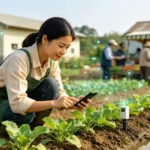
For example, a farmer can take a photo of a leaf with a smartphone and receive an instant diagnosis. The AI model, trained on millions of images, identifies the disease and recommends treatment. This is particularly valuable in regions where access to agricultural experts is limited. It enables farmers to act quickly, reducing crop losses and pesticide use.
AI-powered traps and sensors can also monitor pests automatically. Cameras and sensors in the field capture images of insects, and AI identifies the species and counts the population. This provides real-time monitoring without manual inspection, enabling timely and targeted interventions.
Yield Prediction
Predicting crop yields accurately is valuable for farmers, buyers, insurers, and policymakers. AI models can predict yields by analyzing data from multiple sources: satellite imagery, weather records, soil data, and historical yields. These models can forecast yields weeks or months before harvest, giving stakeholders time to plan.
Yield prediction helps farmers decide how much fertilizer to apply, when to harvest, and how to market their crops. It helps buyers secure supply and manage inventory. It helps insurers assess risk and set premiums. And it helps governments anticipate food shortages and plan imports or aid.
Accuracy depends on data quality and model design. In well-monitored fields with abundant data, AI models can achieve high accuracy. In data-scarce regions, predictions are less reliable. Efforts are underway to develop models that work with limited data, using transfer learning and other techniques.
Precision Irrigation and Fertilization
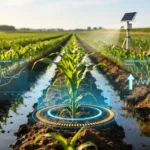
AI can optimize irrigation and fertilization by analyzing sensor data, weather forecasts, and crop models. Instead of applying water and nutrients on a fixed schedule, AI recommends applications based on actual conditions and crop needs. This saves resources, reduces environmental impact, and improves crop health.
For example, an AI system might integrate soil moisture data, weather forecasts, and evapotranspiration models to determine exactly when and how much to irrigate. It can then control irrigation valves automatically, delivering water only where it is needed. Similar approaches apply to fertilization, where AI recommends nutrient applications based on soil tests, crop stage, and yield goals.
Crop and Variety Selection
Choosing the right crop and variety for a given field is a complex decision. It depends on soil type, climate, water availability, market prices, and many other factors. AI can help by analyzing historical data and predicting how different crops and varieties will perform under different conditions.
Recommendation systems can suggest the best options for a specific field and season. They can also account for risk, helping farmers diversify and reduce exposure to price and weather volatility. This is especially valuable in a changing climate, where historical patterns are less reliable.
Autonomous Machinery and Robotics
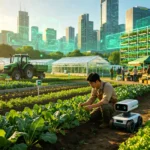
AI is essential for autonomous machinery and robotics. Self-driving tractors, harvesters, and robots rely on AI to perceive their environment, make decisions, and navigate fields. Computer vision enables them to identify obstacles, avoid collisions, and perform tasks with precision.
For example, an autonomous weeding robot uses computer vision to distinguish between crops and weeds. It then removes the weeds mechanically or with targeted herbicides, reducing chemical use. An autonomous harvester uses AI to identify ripe fruits and pick them without damaging the plant. These systems address labor shortages and improve efficiency.
Supply Chain and Market Intelligence
AI is also transforming agricultural supply chains and markets. Demand forecasting models predict how much of a product will be needed, helping farmers and distributors plan. Price prediction models forecast market trends, helping farmers decide when to sell. Logistics optimization models reduce transport costs and spoilage.
AI-powered platforms connect farmers with buyers, providing transparency and reducing intermediaries. They can also verify sustainability claims and support traceability, as discussed in a later article on blockchain. These applications improve efficiency and create new opportunities for farmers.
Chatbots and Advisory Services
AI-powered chatbots and virtual assistants provide farmers with instant advice and support. They can answer questions about crop management, pest control, weather, and market prices. They can be accessed via smartphone, making them available even in remote areas.
These tools are particularly valuable for smallholder farmers, who may lack access to extension services. By providing personalized, timely advice, they help farmers improve productivity and incomes. As language models improve, these assistants will become more capable and more natural to interact with.
Benefits of AI in Agriculture
AI delivers several benefits to agriculture. It increases productivity by enabling better decisions and more precise operations. It reduces costs by optimizing input use and reducing waste. It improves sustainability by reducing water, fertilizer, and pesticide use. It enhances resilience by helping farmers anticipate and respond to risks. And it improves food safety and quality by enabling better monitoring and traceability.
AI also helps address labor shortages by automating tasks and supporting decision-making. It can capture and preserve expert knowledge, making it available to more farmers. And it can process vast amounts of data quickly, providing insights that would be impossible for humans to derive manually.
Challenges and Limitations
Despite its potential, AI in agriculture faces several challenges. Data quality and availability are major barriers. AI models require large, high-quality datasets to perform well. In many regions, such data is scarce or unavailable. Collecting and labeling data is expensive and time-consuming.
Cost is another barrier. Developing and deploying AI systems requires investment in hardware, software, and expertise. While cloud services have reduced costs, many farmers, especially smallholders, cannot afford these technologies. Shared platforms and low-cost solutions are needed to broaden access.
Digital skills are also a limitation. AI systems require users who can interpret their outputs and integrate them into farm management. Training and support are essential. User-friendly interfaces and advisory services can help bridge the gap.
Data ownership and privacy are growing concerns. Farmers may be reluctant to share data if they fear it will be used against them or sold without their consent. Clear policies and regulations are needed to protect farmers’ rights and build trust.
Algorithmic bias is another risk. If training data is not representative, AI models may perform poorly for certain crops, regions, or farming systems. This can exacerbate inequalities. Diverse and inclusive datasets are essential to ensure that AI benefits everyone.
Finally, there is the question of transparency and accountability. Many AI models, especially deep learning models, are “black boxes”—it is difficult to understand how they reach their conclusions. This can be a problem when decisions have significant consequences. Explainable AI is an active area of research that aims to make AI more transparent and trustworthy.
The Future of AI in Agriculture
The future of AI in agriculture is full of promise. AI models are becoming more accurate, more efficient, and more accessible. Foundation models—large AI models trained on vast datasets—are being adapted to agriculture, enabling new applications and reducing the need for custom development.
Edge AI, which runs AI models on devices in the field rather than in the cloud, is reducing latency and bandwidth requirements. This enables real-time decision-making in remote areas with limited connectivity. It also improves privacy and security by keeping data local.
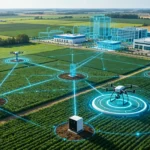
Integration with other technologies is advancing. AI is being combined with IoT, drones, robotics, and blockchain to create comprehensive smart farming systems. Data from multiple sources is fused to provide holistic insights and automated actions. This integration is essential for the autonomous farms of the future.
Perhaps most importantly, AI is becoming more accessible to smallholder farmers. Mobile phone-based AI services, shared platforms, and open-source models are lowering barriers to entry. In developing countries, AI is being used to provide advice, detect diseases, and improve market access. This has the potential to transform livelihoods and food security on a global scale.
Conclusion
Artificial intelligence is the brain of smart agriculture. It transforms the data collected by sensors, drones, and satellites into insights, predictions, and recommendations. It detects diseases, predicts yields, optimizes irrigation and fertilization, guides robots, and supports supply chains. It increases productivity, reduces costs, and improves sustainability. While challenges remain, including data quality, cost, skills, and trust, the trajectory is clear. AI is becoming an indispensable tool for modern farming.
In the next article in this series, we will explore robotics and automation—the hands of smart agriculture. Robots are taking on tasks that were once performed by humans, from planting and weeding to harvesting and sorting. Together with AI, they are paving the way for autonomous farms that can operate with minimal human intervention.
Next in the series: “Robots in the Fields: Automation and the Rise of Autonomous Farming”