From Farm to Fork: Blockchain and Digital Traceability in Agriculture
Series: The Future of Agriculture — Article 7 of 12
Introduction
In the previous articles in this series, we focused on the production side of agriculture. We explored how sensors, drones, AI, and robots are transforming the way food is grown. But farming does not end at the farm gate. Food must be processed, packaged, transported, stored, and sold before it reaches consumers. This journey—often called the food supply chain—is long, complex, and increasingly global.
Complexity brings risks. Food can be contaminated, adulterated, or mislabeled. Products can be recalled, causing financial losses and reputational damage. Consumers, meanwhile, are demanding more information about where their food comes from and how it was produced. They want assurance that it is safe, sustainable, and ethically sourced.
This is where blockchain and digital traceability come in. These technologies create a transparent, tamper-resistant record of a product’s journey from farm to fork. They enable rapid recalls, reduce fraud, and build trust between producers and consumers. In this article, we explore what blockchain is, how it works in agriculture, what it can achieve, and what challenges remain.
What Is Blockchain?
Blockchain is a distributed ledger technology. A ledger is simply a record of transactions. In traditional systems, a central authority—a bank, a government, or a company—maintains the ledger and controls access. In a blockchain, the ledger is distributed across many computers, called nodes. Each node has a copy of the ledger, and all copies must agree on the record.
Transactions are grouped into blocks. Each block contains a set of transactions, a timestamp, and a cryptographic hash of the previous block. This linking of blocks creates a chain—hence the name blockchain. Because each block references the previous one, altering any block would require changing all subsequent blocks, which is computationally infeasible. This makes blockchain highly resistant to tampering.
Blockchain can be public or private. Public blockchains, like Bitcoin and Ethereum, are open to anyone. Private blockchains are restricted to authorized participants. In agriculture, private or consortium blockchains are more common, because supply chain data is often commercially sensitive and participants must be identified and trusted.
Smart contracts are another important feature. A smart contract is a self-executing program stored on the blockchain. It automatically enforces the terms of an agreement when predefined conditions are met. In agriculture, smart contracts can automate payments, release shipments, or trigger recalls based on verified data.
Why Agriculture Needs Traceability
Traceability is the ability to track a product through every stage of the supply chain. It answers questions such as: Where was this food grown? Which farm produced it? When was it harvested? How was it processed? Who transported it? Where has it been stored?
Traceability is important for several reasons. First, food safety. When contamination occurs, traceability enables rapid identification of the source and scope of the problem. Affected products can be recalled quickly, reducing harm to consumers and limiting financial losses. Without traceability, recalls are slower, broader, and more costly.
Second, quality assurance. Traceability allows producers and retailers to verify that products meet quality standards. It can confirm that a product is organic, non-GMO, or sustainably produced. It can verify that cold chain requirements were maintained during transport. This protects brand reputation and supports premium pricing.
Third, fraud prevention. Food fraud—the deliberate mislabeling or adulteration of food—is a significant problem. Examples include substituting cheaper ingredients, misrepresenting origin, or falsifying organic certification. Traceability makes fraud harder and easier to detect. Blockchain, in particular, makes records tamper-resistant, providing strong evidence of authenticity.
Fourth, consumer trust. Consumers increasingly want to know about their food. They want transparency about farming practices, environmental impact, and labor conditions. Traceability platforms allow consumers to scan a QR code and see a product’s history. This builds trust and can command higher prices.
Fifth, regulatory compliance. Governments around the world are tightening food safety regulations. In the United States, the Food Safety Modernization Act (FSMA) includes traceability requirements. In the European Union, regulations require origin labeling for many products. Blockchain-based traceability can help companies comply efficiently and demonstrate compliance to regulators.
How Blockchain Enables Traceability
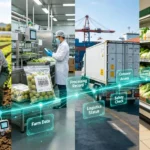
Blockchain enables traceability by creating a shared, immutable record of a product’s journey. Each participant in the supply chain—farmer, processor, transporter, distributor, retailer—records relevant events on the blockchain. These records are verified, timestamped, and linked to the product.
For example, a farmer might record the planting date, seed variety, and farming practices. A processor might record the processing date, methods, and quality checks. A transporter might record pickup and delivery times, temperatures, and locations. A retailer might record receipt and sale. Each event is added to the blockchain and cannot be altered later.
Consumers can access this record through a QR code or app. They can see where the product came from, how it was produced, and how it was handled. This transparency differentiates products and builds loyalty. It also enables rapid recalls: if a problem is detected, the blockchain can identify exactly which products are affected and where they are.
IoT sensors play a crucial role in this process. Sensors can automatically record data such as temperature, humidity, and location. This data is fed into the blockchain, reducing manual entry and the potential for errors or fraud. Automated recording ensures that the record reflects actual conditions, not just claimed conditions.
AI can also enhance blockchain traceability. AI algorithms can analyze supply chain data to detect anomalies, predict risks, and optimize logistics. They can flag suspicious patterns that might indicate fraud or contamination. Combined with blockchain’s tamper-resistant records, AI provides powerful tools for supply chain integrity.
Applications in Agriculture
Blockchain and digital traceability are being applied across a wide range of agricultural products. The following sections describe some of the most important applications.
Produce and Fresh Food
Fresh produce is highly perishable and vulnerable to contamination. Traceability is essential for food safety and quality. Blockchain platforms are being used to track fruits, vegetables, and herbs from farm to retailer. Consumers can scan a code and see the farm, harvest date, and transport conditions.
Major retailers and food companies have piloted blockchain traceability for produce. These pilots have demonstrated faster recalls, improved supply chain visibility, and increased consumer engagement. As costs fall and standards emerge, adoption is expected to grow.
Meat and Seafood
Meat and seafood supply chains are complex and prone to fraud. Mislabeling of species, origin, and production methods is common. Blockchain traceability can verify the species, origin, and handling of meat and seafood products. It can confirm that fish were caught legally and sustainably. It can track animals from birth to slaughter, ensuring welfare and health standards.
Several companies now offer blockchain-based traceability for seafood, allowing consumers to verify that their fish was caught in a specific region by a specific vessel. This supports sustainable fishing and helps combat illegal, unreported, and unregulated (IUU) fishing.
Coffee, Tea, and Cocoa
Coffee, tea, and cocoa are global commodities with long, complex supply chains. Smallholder farmers often receive a small share of the final price, and sustainability and labor issues are widespread. Blockchain traceability can connect consumers directly to farmers, verifying origin, farming practices, and fair trade claims.
Several initiatives use blockchain to track coffee from farm to cup. Consumers can scan a code and see the farm, farmer, harvest date, and processing method. This transparency supports premium pricing and improves farmer livelihoods. Similar initiatives exist for tea and cocoa.
Grains and Commodities
Grains such as wheat, rice, and corn are traded in large volumes and often blended from multiple sources. Traceability is challenging but valuable. Blockchain can track grain from farm to elevator to processor, verifying quality, origin, and sustainability claims. It can also support commodity trading and financing, reducing risk and improving efficiency.
Organic and Specialty Products
Organic, non-GMO, and specialty products command premium prices. Fraud and mislabeling are significant risks. Blockchain traceability can verify certification and production methods, protecting consumers and honest producers. It can also support carbon farming and other sustainability claims, as discussed in a later article.
Benefits of Blockchain Traceability
Blockchain traceability delivers several benefits. It improves food safety by enabling rapid recalls and reducing the scope of contamination incidents. It reduces fraud by making records tamper-resistant and verifiable. It builds consumer trust by providing transparency and provenance. It supports premium pricing by differentiating products. It improves supply chain efficiency by providing shared, real-time visibility. And it helps companies comply with regulations and demonstrate sustainability.
For farmers, blockchain traceability can open new markets and increase income. By connecting directly with consumers, farmers can capture more value and tell their story. By verifying sustainable practices, they can access sustainability-linked financing and carbon markets. By participating in traceability programs, they can strengthen relationships with buyers and reduce risk.
Challenges and Limitations
Despite its potential, blockchain traceability faces significant challenges. Cost is a major barrier. Implementing blockchain systems requires investment in technology, integration, and training. For smallholders and small businesses, these costs can be prohibitive. Shared platforms and low-cost solutions are needed to broaden access.
Standards and interoperability are also challenges. There are many blockchain platforms, and they do not always work together. Data formats and protocols vary. This fragmentation limits the value of traceability and makes it difficult to track products across multiple systems. Industry standards and interoperability protocols are essential.
Data quality is another concern. Blockchain ensures that recorded data cannot be altered, but it cannot guarantee that the data was accurate in the first place. If a farmer or processor enters false information, the blockchain will record it faithfully. This is sometimes called the “garbage in, garbage out” problem. IoT sensors and automated data collection can reduce this risk by minimizing human entry.
Scalability is a technical challenge. Public blockchains can be slow and expensive when processing many transactions. Private and consortium blockchains can be faster, but they sacrifice some of the decentralization and trust benefits. New consensus mechanisms and layer-two solutions are addressing these issues, but challenges remain.
Privacy and confidentiality are also concerns. Supply chain data can be commercially sensitive. Participants may not want to share all data with all other participants. Permissioned blockchains and zero-knowledge proofs allow selective disclosure, but these solutions add complexity.
Finally, adoption requires collaboration. Blockchain traceability only works if all participants in the supply chain participate. This requires coordination, trust, and shared incentives. In fragmented supply chains, achieving this collaboration can be difficult. Leadership from large buyers and retailers can help drive adoption.
The Future of Blockchain in Agriculture
The future of blockchain in agriculture is promising. As technology matures and costs fall, adoption is expected to grow. Integration with IoT, AI, and other smart agriculture technologies will enhance the value of traceability. Automated data collection will improve data quality. AI will detect anomalies and predict risks. Smart contracts will automate transactions and enforce agreements.
Regulation will also shape the future. Governments are increasingly requiring traceability for food safety and sustainability. Blockchain can help companies comply efficiently. Digital product passports, which provide comprehensive information about a product’s origin and impact, are being developed in the EU and elsewhere. Blockchain is a natural fit for these initiatives.
Consumer demand will continue to drive adoption. People want to know where their food comes from and how it was produced. They are willing to pay more for products they trust. Blockchain traceability meets this demand and creates new opportunities for producers who embrace transparency.
Perhaps most importantly, blockchain can help make supply chains more equitable. By connecting farmers directly to consumers and verifying sustainable practices, it can increase farmer incomes and support rural development. It can also reduce waste and improve efficiency, benefiting everyone in the supply chain.
Conclusion
Blockchain and digital traceability are transforming the food supply chain. They create transparent, tamper-resistant records of a product’s journey from farm to fork. They improve food safety, reduce fraud, build consumer trust, and support premium pricing. They help companies comply with regulations and demonstrate sustainability.
While challenges remain, including cost, standards, data quality, and collaboration, the trajectory is clear. Blockchain traceability is becoming more accessible, more integrated, and more valuable. In the next article in this series, we will explore vertical farming and controlled-environment agriculture—a different kind of transformation that is reshaping where and how food is grown.
Next in the series: “Vertical Farming and Plant Factories: The Urban Agriculture Revolution”