Vertical Farming and Plant Factories: The Urban Agriculture Revolution
Series: The Future of Agriculture — Article 8 of 12
Introduction
What Is Vertical Farming?
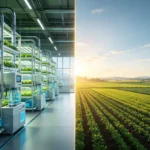
Vertical farming is the practice of growing crops in vertically stacked layers, often in indoor environments. Instead of spreading out across a field, crops are stacked upward, multiplying the growing area per unit of floor space. A single vertical farm can produce the equivalent of many acres of conventional farmland within a building the size of a warehouse.
Vertical farms typically use soilless growing methods. Hydroponics grows plants in nutrient-rich water solutions. Aeroponics suspends plant roots in the air and mists them with nutrients. Aquaponics combines hydroponics with fish farming, using fish waste as fertilizer. These methods use far less water than conventional farming and eliminate soil-borne diseases.
Lighting is provided by LED lamps tuned to the specific wavelengths that plants need for photosynthesis. Climate control systems manage temperature, humidity, carbon dioxide, and airflow. Sensors monitor conditions continuously, and software adjusts them automatically. The result is a highly controlled environment where every variable can be optimized.
What Is a Plant Factory?
The term “plant factory” is often used interchangeably with vertical farming, but it has a more specific meaning. A plant factory is a fully enclosed, controlled-environment facility that produces plants on a commercial scale. It typically uses artificial lighting, automated systems, and precise environmental control to achieve consistent, high-quality output.
Plant factories can be large or small. Some are industrial-scale facilities producing millions of plants per year. Others are small, modular units located in supermarkets, restaurants, or community centers. The key feature is the high degree of control, which enables predictable production regardless of external conditions.
Plant factories are common in Japan, where they produce lettuce, herbs, and other leafy greens. They are also expanding in China, the United States, Europe, and the Middle East. In regions with extreme climates—deserts, cold northern latitudes, polluted cities—plant factories offer a way to produce fresh food locally.
The Technologies Behind Vertical Farming
Vertical farming depends on a convergence of technologies. Understanding these technologies helps explain both the potential and the limitations of the approach.
LED Lighting
LED lighting is the single most important technology enabling vertical farming. Early attempts at indoor farming used fluorescent or high-pressure sodium lamps, which were inefficient and produced excessive heat. LEDs are far more efficient, converting a higher proportion of electricity into usable light. They also produce less heat, allowing lights to be placed close to plants.
LEDs can be tuned to emit specific wavelengths. Plants primarily use red and blue light for photosynthesis, so LEDs can be optimized for those wavelengths. This reduces energy waste and allows researchers to influence plant characteristics—such as leaf size, flavor, and nutrient content—by adjusting the light spectrum.
The cost of LED lighting has fallen dramatically in recent years, making vertical farming more economically viable. However, lighting still accounts for a large share of operating costs, and energy efficiency remains a key area of research.
Hydroponics and Aeroponics
Soilless growing methods are essential for vertical farming. Hydroponics circulates nutrient solutions around plant roots, providing water and nutrients directly. Aeroponics mists roots with nutrient solutions, using even less water. Both methods allow precise control over nutrient delivery, improving growth rates and quality.
These systems recirculate water, reducing consumption dramatically. A hydroponic system can use up to 90 percent less water than conventional farming. This is a major advantage in water-scarce regions. Soilless systems also avoid soil-borne pests and diseases, reducing or eliminating the need for pesticides.
Climate Control and Automation
Climate control systems manage temperature, humidity, carbon dioxide, and airflow. These variables affect photosynthesis, transpiration, and growth. Precise control enables optimal conditions year-round, regardless of external weather.
Automation is also critical. Robots move trays, plant seeds, monitor plants, and harvest crops. Conveyor systems transport plants between growth zones. Software coordinates everything, adjusting conditions based on sensor data and crop models. Automation reduces labor costs and improves consistency.
Sensors and Data Analytics
Sensors monitor temperature, humidity, light, carbon dioxide, pH, and nutrient levels. Cameras and computer vision systems monitor plant health and growth. Data analytics and AI optimize conditions, predict harvests, and detect problems early.
The data generated by vertical farms is enormous. Every plant, every tray, every growth cycle generates data. This data can be used to improve yields, reduce costs, and develop new crop varieties. It also enables traceability, as discussed in the previous article on blockchain.
What Can Be Grown in Vertical Farms?
Not all crops are suitable for vertical farming. The economics favor high-value, fast-growing, compact crops. Leafy greens—lettuce, spinach, kale, arugula—are the most common. Herbs—basil, cilantro, mint, parsley—are also well-suited. Microgreens and sprouts grow quickly and command high prices.
Berries, such as strawberries and blueberries, are increasingly grown in controlled environments. Tomatoes, peppers, and cucumbers can be grown in greenhouses and plant factories, though they require more space and light. Medicinal plants and cannabis are high-value crops that are well-suited to controlled environments.
Staple crops—wheat, rice, corn, potatoes—are generally not economically viable in vertical farms. They require too much light and space, and their market prices are too low to justify the costs. This is an important limitation: vertical farming can supplement, but not replace, conventional agriculture for staple foods.
Benefits of Vertical Farming
Vertical farming offers several compelling benefits. First, land use. By stacking crops, vertical farms produce far more food per unit of land. This reduces pressure on forests, grasslands, and other natural ecosystems. It also allows food production in cities, where land is scarce and expensive.
Second, water use. Hydroponic and aeroponic systems recirculate water, using up to 90 percent less than conventional farming. In a world facing water scarcity, this is a major advantage.
Third, no pesticides. Enclosed environments exclude pests and diseases, eliminating the need for pesticides. This improves food safety and reduces environmental contamination.
Fourth, year-round production. Vertical farms are unaffected by weather, seasons, or climate. They can produce fresh food continuously, regardless of external conditions. This improves food security and stabilizes supply.
Fifth, local production. Vertical farms can be located in or near cities, reducing transport distances and food miles. This improves freshness, reduces spoilage, and lowers carbon emissions from transportation.
Sixth, consistency and quality. Controlled environments produce consistent, high-quality crops. Taste, texture, and nutritional content can be optimized. This is valuable for retailers and consumers who expect uniform products.
Seventh, resilience. Vertical farms are protected from droughts, floods, storms, and other climate shocks. They can continue producing when conventional farms fail. This makes them a valuable component of a resilient food system.
Criticisms and Limitations
Despite these benefits, vertical farming faces significant criticisms. The most important is energy use. Artificial lighting and climate control require substantial electricity. If that electricity comes from fossil fuels, the carbon footprint of vertical farming can be higher than conventional farming. Renewable energy can address this, but it adds cost and complexity.
Economics is another challenge. Vertical farms require large capital investments in buildings, equipment, and technology. Operating costs—especially electricity and labor—are high. Many vertical farming companies have struggled to achieve profitability. Several high-profile failures have raised questions about the viability of the sector.
Crop limitations are also significant. As noted, staple crops are not economically viable in vertical farms. This means vertical farming cannot feed the world on its own. It can supply fresh greens, herbs, and high-value crops, but it cannot replace conventional agriculture for calories.
Scale is another issue. Vertical farms can produce a lot of food in a small area, but the total volume is still small compared to global agricultural production. Scaling up to meet a significant share of demand would require enormous investment and infrastructure.
Technical challenges remain. Pollination, for example, is difficult in enclosed environments. Some crops require wind or insects for pollination, which must be simulated. Diseases can spread rapidly in dense, enclosed systems. And the long-term sustainability of soilless growing systems is not fully understood.
Finally, there are social and economic concerns. Vertical farming is capital-intensive, favoring large companies over small farmers. It may concentrate food production in the hands of a few players. And it may not create many jobs, since it is highly automated. These concerns need to be addressed through policy and business models that promote equity and inclusion.
The Future of Vertical Farming
The future of vertical farming depends on several factors. Energy costs will be critical. As renewable energy becomes cheaper and more abundant, the economics of vertical farming will improve. Advances in LED efficiency will also reduce energy consumption.
Automation and AI will reduce labor costs and improve productivity. Robots will handle planting, harvesting, and maintenance. AI will optimize growing conditions and predict problems. This will make vertical farms more efficient and more profitable.
Integration with other technologies will enhance value. IoT sensors, blockchain traceability, and AI analytics will make vertical farms transparent, efficient, and responsive. They will connect seamlessly with supply chains and consumers.
New crops and new business models will emerge. Researchers are developing dwarf varieties of staple crops that may be suitable for vertical farming. Companies are exploring modular, container-based systems that can be deployed in diverse locations. Business models such as subscription services, on-site production for restaurants and supermarkets, and community-supported agriculture are emerging.
Perhaps most importantly, vertical farming will find its niche. It will not replace conventional agriculture, but it will complement it. It will supply fresh, local, high-value crops to urban markets. It will provide resilience in regions with extreme climates or limited arable land. It will serve as a platform for innovation in plant science and food technology.
Conclusion
Vertical farming and plant factories represent a new frontier in agriculture. They move food production indoors, into controlled environments where every variable can be optimized. They use less water, no pesticides, and far less land. They produce fresh, local food year-round, regardless of climate or season. They offer resilience, consistency, and quality.
But they also face real challenges: energy costs, economics, crop limitations, and scale. They are not a replacement for conventional agriculture, but a complement to it. Their future depends on continued innovation, falling costs, and smart integration with other technologies and food systems.
In the next article in this series, we will explore climate-smart agriculture—the practices and technologies that help farming adapt to climate change while reducing its own environmental impact. Vertical farming is one tool in that effort; there are many others, and together they are shaping a more resilient and sustainable future for food.
Next in the series: “Climate-Smart Agriculture: Building Resilience in a Changing World”