Climate-Smart Agriculture: Building Resilience in a Changing World
Series: The Future of Agriculture — Article 9 of 12
Introduction
In the first article of this series, we identified climate change as one of the most powerful forces reshaping agriculture. Rising temperatures, shifting rainfall patterns, and more frequent extreme weather events are already affecting crop yields, livestock production, and the livelihoods of farmers around the world. Climate change is not a distant threat; it is a present reality that agriculture must confront.
But agriculture is not only a victim of climate change. It is also a contributor. Farming accounts for roughly a quarter of global greenhouse gas emissions, including methane from livestock, nitrous oxide from fertilizers, and carbon dioxide from deforestation and land conversion. This creates a dual challenge: agriculture must adapt to a changing climate while also reducing its own impact on the climate.
Climate-smart agriculture (CSA) is a response to this challenge. It is an approach that aims to achieve three objectives simultaneously: increase productivity and incomes, build resilience to climate change, and reduce greenhouse gas emissions. In this article, we explore what climate-smart agriculture is, the practices and technologies it involves, the challenges it faces, and its role in building a sustainable food future.
What Is Climate-Smart Agriculture?
Climate-smart agriculture is not a single technology or practice. It is a framework for developing agricultural strategies that address the interlinked challenges of food security and climate change. The concept was introduced by the Food and Agriculture Organization (FAO) in 2010 and has since been adopted by governments, researchers, and development organizations around the world.
Climate-smart agriculture has three pillars. The first is productivity: sustainably increasing agricultural productivity and incomes. The second is adaptation: building resilience and reducing vulnerability to climate change. The third is mitigation: reducing greenhouse gas emissions and enhancing carbon sequestration where possible.
These three pillars are not always in harmony. Increasing productivity can increase emissions. Reducing emissions can reduce productivity. Building resilience can require investments that smallholders cannot afford. Climate-smart agriculture recognizes these trade-offs and seeks solutions that balance them. It is context-specific, tailored to local conditions, and focused on outcomes rather than prescriptions.
Why Climate-Smart Agriculture Matters
The case for climate-smart agriculture is urgent. Global temperatures are rising, and the impacts on agriculture are becoming more severe. Heat stress reduces the productivity of staple crops such as wheat, rice, and maize. Droughts and floods destroy harvests and displace farming communities. Pests and diseases are spreading to new regions as temperatures warm. The Intergovernmental Panel on Climate Change (IPCC) warns that climate change will increasingly undermine food security, particularly in vulnerable regions such as sub-Saharan Africa, South Asia, and small island states.
At the same time, agriculture must reduce its emissions. If global warming is to be limited to 1.5 or 2 degrees Celsius, as envisioned in the Paris Agreement, all sectors—including agriculture—must contribute. Agriculture has significant mitigation potential, especially through soil carbon sequestration, improved fertilizer management, and reduced deforestation.
Climate-smart agriculture also matters for economic reasons. Farmers who adopt climate-smart practices can reduce risk, improve yields, and increase incomes. They can access new markets, including carbon markets and sustainability-linked supply chains. They can build resilience to shocks that would otherwise devastate their livelihoods. For governments and development organizations, climate-smart agriculture is a way to achieve food security, poverty reduction, and climate goals simultaneously.
Key Practices and Technologies
Climate-smart agriculture encompasses a wide range of practices and technologies. The following sections describe some of the most important.
Conservation Agriculture
Conservation agriculture is a set of practices that minimize soil disturbance, maintain soil cover, and diversify crop rotations. It includes no-till or minimum-till farming, which avoids plowing and preserves soil structure. It includes cover cropping, which protects soil between cash crops. And it includes crop rotation and intercropping, which improve soil health and reduce pests.
Conservation agriculture improves soil health, increases water retention, and reduces erosion. It also sequesters carbon in the soil, contributing to mitigation. Healthy soil holds more water, making farms more resilient to drought. It also supports beneficial organisms, reducing the need for synthetic inputs. These benefits make conservation agriculture a cornerstone of climate-smart farming.
Precision Agriculture
Precision agriculture, as discussed in earlier articles, uses sensors, GPS, and data analytics to optimize inputs. It reduces fertilizer and pesticide use, lowering emissions and costs. Variable-rate application ensures that nutrients are applied only where they are needed, reducing nitrous oxide emissions and nutrient runoff.
Precision irrigation, guided by soil moisture sensors and weather data, reduces water use and energy consumption. It also improves crop health and yields. Precision agriculture is a key tool for both adaptation and mitigation, helping farmers produce more with less.
Agroforestry
Agroforestry integrates trees and shrubs into crop and livestock systems. Trees provide shade, reduce wind, improve soil health, and diversify income. They also sequester carbon, contributing to mitigation. Agroforestry systems can be more resilient to climate shocks, providing multiple products and income streams.
Examples of agroforestry include alley cropping, where crops are grown between rows of trees; silvopasture, where trees are integrated into pasture systems; and home gardens, where trees, crops, and livestock are combined on small plots. Agroforestry is particularly well-suited to smallholder farmers, who can benefit from diversified production and reduced risk.
Improved Livestock Management
Livestock production is a major source of methane, a potent greenhouse gas. Improved management practices can reduce emissions and increase productivity. These include better feeding, which reduces methane per unit of milk or meat; improved breeding, which increases productivity; and manure management, which captures methane for energy or reduces emissions.
Grazing management also matters. Rotational grazing, where animals are moved between paddocks, improves pasture health and sequesters carbon. Silvopasture, which integrates trees into grazing systems, provides shade and reduces heat stress. These practices improve animal welfare, productivity, and environmental performance.
Water Management
Water management is critical for adaptation. Climate change is altering rainfall patterns, making water less predictable. Practices such as rainwater harvesting, drip irrigation, and soil moisture conservation help farmers use water more efficiently. They reduce vulnerability to drought and improve yields.
Wetland restoration and managed aquifer recharge can also enhance water availability. These practices store water during wet periods and release it during dry periods, buffering against variability. They also support ecosystems and biodiversity.
Climate-Resilient Crops
Developing crops that tolerate heat, drought, salinity, and pests is essential for adaptation. Plant breeding, both conventional and biotechnological, has produced varieties that perform better under stress. Examples include drought-tolerant maize, heat-tolerant wheat, and salt-tolerant rice.
Genetic diversity is also important. Farmers who grow a mix of varieties and crops are less vulnerable to pests, diseases, and weather extremes. Seed banks and community seed systems preserve diversity and ensure access to resilient varieties. These resources are essential for adapting to an uncertain future.
Carbon Farming and Soil Carbon Sequestration
Carbon farming refers to practices that sequester carbon in soil and vegetation. These include conservation agriculture, agroforestry, cover cropping, and rotational grazing. By storing carbon, farms can offset emissions and contribute to climate mitigation.
Carbon markets allow farmers to earn credits for sequestering carbon. These credits can be sold to companies or governments seeking to offset their emissions. This creates a new income stream for farmers and incentivizes climate-smart practices. However, measuring and verifying soil carbon is challenging, and markets are still developing.
Renewable Energy and Energy Efficiency
Agriculture uses significant energy for irrigation, machinery, heating, and cooling. Switching to renewable energy—solar, wind, biogas—reduces emissions and costs. Energy efficiency measures, such as improved irrigation pumps and efficient lighting, also reduce consumption.
On-farm renewable energy can also provide income. Solar panels on barns and greenhouses generate electricity that can be sold to the grid. Biogas digesters convert manure into energy, reducing methane emissions and providing fuel. These systems improve sustainability and profitability.
Digital Technologies and Climate-Smart Agriculture
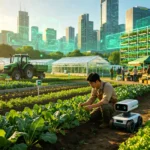
The technologies discussed throughout this series—sensors, drones, AI, blockchain, and robotics—are powerful enablers of climate-smart agriculture. They provide the data and precision needed to implement climate-smart practices effectively.
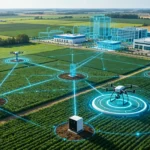
Sensors monitor soil moisture, temperature, and nutrients, enabling precise irrigation and fertilization. Drones and satellites monitor crop health and detect stress early, allowing timely interventions. AI analyzes data to predict weather, pests, and yields, supporting proactive management. Blockchain provides traceability, verifying sustainability claims and enabling carbon markets. Robotics enables precise planting, weeding, and harvesting, reducing inputs and emissions.
Digital technologies also enable climate-smart agriculture at scale. They allow farmers, advisors, and policymakers to monitor conditions, target interventions, and measure outcomes. They support coordination across landscapes and supply chains. They make climate-smart practices more accessible, efficient, and effective.
Challenges and Barriers
Despite its potential, climate-smart agriculture faces significant challenges. Financing is a major barrier. Many climate-smart practices require upfront investment, and benefits may take years to materialize. Smallholders often lack access to credit and insurance. Public and private financing mechanisms are needed to support adoption.
Knowledge and capacity are also limited. Climate-smart agriculture requires new skills and knowledge. Extension services, training programs, and farmer-to-farmer learning are essential. Digital tools can help, but they must be accessible and user-friendly.
Policy and institutional support are critical. Governments must create enabling environments through policies, regulations, and incentives. This includes supporting research, providing extension services, and creating markets for climate-smart products. It also includes integrating climate-smart agriculture into national climate plans and development strategies.
Measurement and verification are challenging. Quantifying emissions reductions and carbon sequestration is difficult and expensive. Standardized methods and technologies are needed to ensure credibility and enable carbon markets. This is an active area of research and development.
Equity is another concern. Climate-smart agriculture must benefit smallholders, women, and marginalized communities. Otherwise, it may exacerbate inequalities. Inclusive approaches, targeted support, and participatory research are essential.
Finally, there is the risk of maladaptation. Some practices that appear climate-smart may have unintended consequences. For example, planting trees in inappropriate locations can reduce water availability or displace food crops. Careful planning, monitoring, and evaluation are needed to avoid harm.
The Future of Climate-Smart Agriculture
The future of climate-smart agriculture is closely tied to the future of agriculture itself. As climate change intensifies, the need for adaptation and mitigation will grow. Climate-smart agriculture will become not just an option but a necessity.
Technological advances will continue to enable climate-smart practices. Sensors, AI, and robotics will become more capable and more affordable. Digital platforms will connect farmers, advisors, and markets. Data will drive decisions and verify outcomes.
Policy will also evolve. Governments are increasingly recognizing the importance of climate-smart agriculture. National climate plans, carbon markets, and sustainability standards are creating incentives for adoption. International cooperation will be essential, especially for smallholders in developing countries.
Consumer demand will play a role. People want food that is produced sustainably and ethically. They are willing to pay more for products that meet these standards. Climate-smart agriculture can meet this demand and create new market opportunities.
Perhaps most importantly, climate-smart agriculture will require a shift in mindset. Farming must be seen not only as a source of emissions but also as a solution. With the right practices and technologies, agriculture can sequester carbon, restore ecosystems, and build resilience. It can be part of the climate solution, not just part of the problem.
Conclusion
Climate-smart agriculture is an approach that addresses the dual challenge of food security and climate change. It aims to increase productivity, build resilience, and reduce emissions. It encompasses a wide range of practices—conservation agriculture, precision farming, agroforestry, improved livestock management, water management, climate-resilient crops, carbon farming, and renewable energy. It is enabled by digital technologies and supported by policy, finance, and knowledge.
While challenges remain, including financing, knowledge, policy, measurement, equity, and maladaptation, the trajectory is clear. Climate-smart agriculture is becoming more accessible, more effective, and more urgent. It is essential for building a food system that can feed the world while protecting the planet.
In the next article in this series, we will explore the question of inclusion: can smart agriculture benefit smallholder farmers? This is one of the most important questions facing the future of agriculture, and it will determine whether the transformation underway is equitable and just.
Next in the series: “Can Smallholders Benefit? Inclusion and Equity in Smart Agriculture”