The Future of Agriculture: A Vision for 2035 and Beyond
Series: The Future of Agriculture — Article 12 of 12
Introduction
We began this series with a simple observation: agriculture must change. Population growth, resource depletion, climate change, labor shortages, and shifting consumer expectations are creating pressures that traditional farming cannot adequately address. Over the past eleven articles, we have explored the technologies, practices, policies, and business models that are driving the transformation. We have examined sensors and drones, AI and robots, blockchain and vertical farms, climate-smart practices and inclusion, policy and investment.
Now we arrive at the final article in the series. It is time to look forward—to imagine what agriculture might look like in 2035 and beyond. This is not about predicting the future with certainty. The future is shaped by choices, and many paths are possible. But by understanding the trends and forces at work, we can sketch a vision of what may come and consider what kind of food system we want to build.
This article explores the future of agriculture from several angles: the technologies that will mature, the farms that will emerge, the food system that will evolve, and the choices that will determine outcomes. It concludes with a reflection on the purpose of agriculture and the responsibilities that come with transformation.
The Technologies of 2035
By 2035, many of the technologies discussed in this series will have matured. They will be more capable, more affordable, and more integrated. Let us consider what each might look like.
Sensing and Data
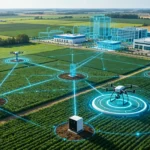
Sensors will be ubiquitous, small, and inexpensive. They will be embedded in soil, plants, machinery, and buildings. They will harvest energy from their environment, operating for years without maintenance. They will communicate wirelessly, forming dense networks that monitor every aspect of the farm.
Satellites and drones will provide continuous, high-resolution imagery. Constellations of small satellites will offer daily or hourly coverage. Drones will be autonomous, launching from docking stations, flying pre-programmed routes, and returning to recharge. Data will flow seamlessly from field to cloud to farmer.
AI will make sense of this data. Models will predict weather, pests, diseases, and yields with high accuracy. They will recommend actions and automate decisions. They will learn continuously, improving with every season. Farmers will interact with AI through natural language, asking questions and receiving advice in real time.
Robotics and Automation
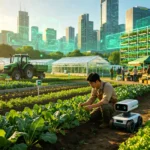
Robots will be common on farms by 2035. Autonomous tractors will prepare fields, plant seeds, and apply inputs with precision. Weeding robots will patrol fields, removing weeds without herbicides. Harvesting robots will pick fruits and vegetables with human-like dexterity. Drones will spray, pollinate, and monitor.
Farms will operate with minimal human intervention. Farmers will supervise fleets of robots, monitoring their performance and intervening when needed. Robots will work day and night, in all weather, without fatigue. They will be modular, with interchangeable tools for different tasks. They will be shared, leased, or owned cooperatively, making them accessible to farms of all sizes.
In controlled environments—greenhouses, vertical farms, plant factories—automation will be near-complete. Robots will plant, tend, and harvest crops in sealed, sterile environments. Production will be predictable, consistent, and year-round. These facilities will be located in cities, providing fresh food close to consumers.
Biotechnology and Breeding
Biotechnology will produce crops that are more resilient, nutritious, and productive. Gene editing will create varieties that tolerate drought, heat, salinity, and pests. They will require less water, fertilizer, and pesticide. They will be tailored to local conditions and consumer preferences.
Alternative proteins—plant-based, fermented, and cultivated—will become mainstream. They will supplement conventional meat and dairy, reducing pressure on land and water. Precision fermentation will produce proteins, fats, and flavors with minimal environmental impact. Cultivated meat will be produced at scale, though challenges remain.
Microbiome science will enhance soil health and plant growth. Microbial inoculants will replace some synthetic inputs, reducing emissions and improving soil fertility. Understanding of plant-microbe interactions will enable new approaches to pest control and nutrient management.
Blockchain and Digital Infrastructure
Blockchain and digital traceability will be standard. Every product will have a digital identity, recording its origin, production methods, and journey through the supply chain. Consumers will scan a code and see the full history of their food. Smart contracts will automate payments, insurance, and compliance.
Digital infrastructure will be public and interoperable. Data will be shared securely among farmers, advisors, researchers, and regulators. Farmers will own and control their data, benefiting from its use. Open standards will prevent lock-in and promote competition.
Energy and Sustainability
Farms will be powered by renewable energy. Solar panels, wind turbines, and biogas digesters will generate electricity and heat. Farms will be net energy producers, selling surplus to the grid. Energy storage will smooth supply and demand. Electric machinery will replace diesel, reducing emissions and noise.
Agriculture will be carbon-neutral or carbon-negative. Soil carbon sequestration, agroforestry, and reduced emissions will offset remaining greenhouse gases. Carbon markets will reward farmers for climate-smart practices. Farms will be recognized as providers of ecosystem services—clean water, biodiversity, carbon storage.
The Farms of 2035
What will farms look like in 2035? They will be diverse, as they are today, but technology will be woven into every type.
Large-Scale Commercial Farms
Large farms will be highly automated and data-driven. They will operate fleets of autonomous machines, monitored from control centers. They will use AI to optimize every decision, from planting to harvest to marketing. They will be integrated with supply chains, providing traceability and sustainability data.
These farms will produce staple crops—wheat, rice, corn, soy—efficiently and sustainably. They will also produce specialty crops for premium markets. They will be managed by skilled technicians and agronomists, supported by AI and robotics.
Smallholder Farms
Smallholder farms will also benefit from technology, though adoption will be uneven. Mobile phones will be the primary interface. Farmers will receive weather forecasts, market prices, and agronomic advice. They will use low-cost sensors and shared equipment. Cooperatives will provide access to machinery, inputs, and markets.
Smallholders will be connected to global markets through digital platforms. They will earn premiums for sustainable, traceable products. They will participate in carbon markets and receive payments for ecosystem services. Their livelihoods will improve, though challenges will remain.
Urban and Vertical Farms
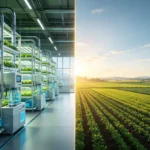
Urban and vertical farms will be common in cities. They will produce fresh greens, herbs, and berries for local consumption. They will be integrated into buildings, rooftops, and unused spaces. They will use renewable energy and recirculated water. They will provide jobs and community benefits.
These farms will not replace conventional agriculture, but they will supplement it. They will reduce food miles, improve freshness, and enhance urban resilience. They will serve as living laboratories for innovation in plant science and food technology.
Regenerative and Agroecological Farms
A growing number of farms will adopt regenerative and agroecological practices. They will prioritize soil health, biodiversity, and ecosystem services. They will integrate crops, livestock, and trees. They will use minimal synthetic inputs. They will be certified and rewarded for their environmental performance.
These farms will demonstrate that productivity and sustainability can go hand in hand. They will inspire others and shape policy. They will produce food that is healthy, nutritious, and ethically produced.
The Food System of 2035
The food system will also transform. It will be more transparent, resilient, and sustainable. It will deliver food that is safe, nutritious, and affordable. It will waste less and recycle more.
Transparency and Trust
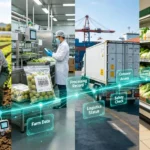
Consumers will know where their food comes from and how it was produced. They will access this information through apps and QR codes. They will trust the food system because it is transparent and verifiable. Fraud and adulteration will be rare, detected quickly by AI and blockchain.
Resilience and Diversity
The food system will be more resilient. Diverse production systems, local supply chains, and global trade will buffer shocks. Climate-smart practices will reduce vulnerability. Early warning systems will predict and prevent crises. Food security will improve, though challenges will persist.
Sustainability and Circularity
The food system will be more sustainable. Emissions will be reduced. Water will be conserved. Waste will be minimized. Byproducts will be valorized. Packaging will be recyclable or compostable. The circular economy will be the norm.
Nutrition and Health
Food will be more nutritious. Biofortified crops, alternative proteins, and personalized nutrition will improve health outcomes. Food waste will be reduced. Access to healthy food will improve, though inequalities will remain.
Choices That Will Shape the Future
The future is not predetermined. It will be shaped by choices made by governments, companies, farmers, and consumers. Several critical choices stand out.
Invest in Public Goods
Governments must invest in public goods: research, infrastructure, education, and data. These are the foundations of innovation and inclusion. Without them, the benefits of smart agriculture will be concentrated and unequal.
Ensure Equity and Inclusion
Policies must ensure that smallholders, women, and marginalized communities benefit. Shared platforms, mobile-first solutions, and inclusive business models can help. Without deliberate effort, inequalities will deepen.
Protect Data and Privacy
Data governance must protect farmers’ rights and ensure fair benefit sharing. Farmers should own and control their data. Transparent rules and accountability mechanisms are essential.
Promote Competition and Openness
Markets must remain competitive and open. Antitrust enforcement, open standards, and support for smaller players are important. Concentration of power in a few companies can harm farmers and consumers.
Address Climate Change
Agriculture must reduce emissions and adapt to climate change. Climate-smart practices, renewable energy, and carbon markets are essential. Without action, climate change will undermine food security and development.
Foster Global Cooperation
Agriculture is global. Trade, investment, and knowledge flows across borders. International cooperation is essential for sharing technology, financing development, and managing risks. No country can solve these challenges alone.
The Purpose of Agriculture
As we look to the future, it is worth reflecting on the purpose of agriculture. Agriculture is not just an industry. It is the foundation of human civilization. It provides food, fiber, and livelihoods. It shapes landscapes, cultures, and communities. It connects us to nature and to each other.
The transformation of agriculture is not just about technology. It is about values. What kind of food system do we want? What kind of rural communities do we want? What kind of relationship do we want with the natural world? These are questions that technology alone cannot answer. They require dialogue, deliberation, and democratic choice.
Smart agriculture offers tools that can help us achieve our goals. But tools are only as good as the purposes they serve. If we use them to concentrate power, exploit workers, and degrade the environment, they will amplify harm. If we use them to empower farmers, improve livelihoods, and restore ecosystems, they will amplify good.
The choice is ours. The future of agriculture is not something that happens to us. It is something we create.
Conclusion: A Call to Action
This series has explored the development and prospects of smart agriculture. We have examined the challenges driving transformation, the technologies enabling it, the applications delivering value, the challenges limiting adoption, and the policies and business models scaling it. We have asked who benefits and how to ensure inclusion. And we have imagined what the future might hold.
The transformation of agriculture is underway. It is driven by necessity and enabled by innovation. It offers the promise of a food system that is more productive, sustainable, resilient, and equitable. But that promise is not guaranteed. It depends on choices—by governments, companies, farmers, and consumers.
The task ahead is urgent. Climate change is accelerating. Population is growing. Resources are shrinking. The window for action is narrowing. We cannot afford complacency or delay.
But the task is also inspiring. Agriculture is being reinvented. New technologies are empowering farmers. New practices are restoring landscapes. New business models are creating value. A new generation is bringing energy and ideas to farming.
The future of agriculture is being written now. Let us write it wisely.
This concludes the series “The Future of Agriculture.” Thank you for reading.